Thursday, August 21, 2008

Impact

In Engineers Without Borders we have this obsession with the word impact. Within our own little microculture, it’s become synonymous with positive change for the world’s poor. As an organization we try to make sure everything we do – be it the overseas projects we’re involved with or the in-Canada advocacy campaigns that we run – has impact. We spend time and energy planning to have it, being critical of those who aren’t having it, trying to decide if we’re having it and, hopefully, actually having it.

Yet for all this obsessing, I approached this summer in Ghana with relatively little optimism about having impact, at least direct impact through my work overseas. I didn’t think four months was long enough to affect lasting and meaningful change within any organization or group that would directly benefit the poorest Ghanaians. I saw the main return on the time and money invested in me as a Junior Fellow to be what I shared with people in Canada and how the experience affected me on an individual level (and how I used that experience in the future).

At the same time, I recognized the need to try to have impact. Not only is it important to me on a philosophical level, but I think trying to have impact is the only way to really understand why it’s so difficult.

With the NILRIFACU rice farmer and processor cooperative I had planned to use the computer as a tool for teaching better record keeping and analysis, which I in turned hope would increase the profitability of the group and the ten thousand dollar marketing fund they’re supposed to be managing. Increasing their profitability would (I hypothesized) allow them to provide better services to their members, thereby reducing poverty on the ground. I ended up working with two or three of the group’s members and got as far as MS Word and Excel, letter writing and entering their previous accounts into the computer. There are a couple of major reasons that events didn’t go exactly as planned, mostly that I overestimated their existing record keeping skills and that farmers are very busy people during the rainy season.


Zakeria learned MS office and excel.


Zakeria, Ayesha and 'Assembly Man' would often teach each other computer skills.

I also conducted a profitability study of a new variety of rice called the New Rice for Africa (NERICA). I initially got interested in the rice because of its dependence on chemical fertilizer and the recent growth in world fertilizer prices. My study included a theoretical section in which I attempted to illustrate the relative profitability of NERICA with changes in fertilizer prices, as well as a case study where a presented the applied profitability of NERICA for farmers in a village where I stayed for a week.


I did a profitability study of NERICA rice.

During the last week of my placement I made a PowerPoint presentation of my report to my office of the Ministry of Food and Agriculture and had a group discussion about it with the management and agricultural extension agents. As the background data was pretty limited, it was tough to make a lot of solid recommendations based on the results. It did generate some good critical discussion however. As EWB and MoFA are looking to pursue an Agriculture As A Business strategy, I hope my report will be able to serve as loose template for future market and profitability analysis, and that it will ultimately have an indirect impact on farmers.

So did I have the ever elusive impact? Probably not. At least not on the scale I wanted. I made some incredible friends; when I left my family gave me such nice gifts that I felt terrible for having questioned how much was too much to give them. My two friends from the rice coop, Ayesha and Zakeria, gave me gifts as well and came to the bus station at six in the morning to see me off. Each volunteer has had a different experience in Ghana, but everyone that I’ve met and worked with in this country has been incredible to me. And so perhaps I’ve made small impact on their individual lives? It’s not measurable and it won’t change the world, but it means something to me.


My host family was incredible to me during my stay in Ghana.


I was so excited with some of my friend Mohammed's wardrobe that he took me to get my own suit made up.


Once tried cooking pasta and salad for my family. They couldn't handle the lack of salt, oil and pepper.

As for impact on people in Canada, it is largely to be determined once I return and try to share my experience. I hope you’ve enjoyed reading my blog and that you’ve got something out of it. It’s a little late for feedback, but I’m still curious as to what people learned from reading it and what it made them think about or do. Please post a comment at the end of this post if you have anything to contribute.

I’ve thought immensely about how this experience has impacted me personally. Perhaps part of it I won’t understand until I’m home and can see myself in that environment. That being said, I want to shy away from any grand proclamations about a new outlook on life. It’s not that I don’t think I’ve changed, but something about over sensationalizing the experience doesn’t feel right. Ghana was probably the hardest thing I’ve ever done. At the same time, there were days when the sunshiny craziness of life here made me swear I’d have to come back.

Most of all I’ve been touched by the simple sincerity in the people and relationships I’ve made. Something about that honesty makes me want to be a little more honest with myself. Life is so structured; it’s easy to get lost in the details. What I've seen and learned this summer makes me want to lose some of that structure and open myself to the more of the huge range of opportunities that the world has to offer.

The twelve other volunteers and I board the plane to Amsterdam tonight. It’s tough to describe the group’s mood. Other than general excitement about seeing friends, eating cheese and not being heckled at, most of us are pretty relaxed. It all feels a little anti-climactic, but perhaps that’s how it should be. Goodbyes have taken on a new meaning for me. I’ve decided there’s a certain sincerity in simplicity: sometimes the most important things don’t need to be said.


All the Junior Fellow volunteers in Ghana got together for a final workshop in Tamale before departing for Canada.

Thursday, July 31, 2008

The Village of Kukuo

There is absolutely no coco grown in the village of Kukuo, nor is there in most of Northern Ghana. There are however, some of the nicest people anyone anywhere could hope to meet and I had the privilege of doing just that this past week.


The village of Kukuo at sunset.

Most Junior Fellow volunteers with EWB spend at least one week living in a village. The idea is to gain a better understanding of rural livelihoods and some of the challenges facing the poorest people in developing countries. I chose to visit the community of my friend Tuferu, the NILRIFACU rice cooperative’s store keeper. The goals of my stay were threefold:

1. Gain a better understanding of rural livelihoods and poverty in Ghana.
2. Learn more about the farmer members of the NILRIFACU rice cooperative and the services NILRIFACU provides.
3. Talk to farmers growing the new NERICA rice variety and collect data on the relative profitability of the crop. Also investigate alternatives for enhancing soil fertility, as NERICA typically requires large inputs of chemical fertilizer.

As Parker Mitchel (EWB co-CEO) recently pointed out, the good thing about trying to hit three birds with one stone is that you’re bound to take down at least one. I’d like to think I’ve done more than that, but you can judge for yourself.

Kukuo and My Hosts

The village of Kukuo is two miles outside Kumbungu, the largest centre in the Tolon/Kumbungu District. Kukuo has roughly twenty compound houses and four to five hundred residents. Although the village does not have electricity, it has the good fortune of being located on the pipeline carrying water to the regional capital of Tamale. As a result, residents have access to standpipes distributed throughout the community. Although the water looks a bit murky some days, it’s actually fairly clean and I drank it throughout my stay.


A water pipeline passes by Kukuo on its way to Tamale.


Kukuo residents have access to standpipes for water.

Tuferu has one wife and three boys aged six, nine and fourteen. His house is made up of his direct family, his parents, several of his brothers and their families and a couple of his unmarried sisters. There are twenty-four people in total. The household’s main source of income is farming. Maize and rice are the two largest crops; maize being grown primarily for consumption and rice being grown for sale. The household also grows beans, cassava, yam, bambara beans, cowpea, sorghum, millet, soybean, peppers and tomatoes.


The family plants maize outside their compound.


NERICA rice is planted in the lowland areas, further from the house.


I got to help Tuferu and his son Fatowu transplant tomatoes.

Tuferu’s family keeps livestock including goats, sheep, cattle, chickens and guinea fowl. Livestock often serve as a ‘bank account’; animals can be bought or sold as money accumulates or runs out. In addition, bull ox are used to plough fields, reducing the community’s dependence on tractors. Other households without bull ox can pay Tuferu the equivalent of fifteen Canadian dollars to plough one acre. Theft of cattle and sheep has become a serious issue in the area. Tuferu’s oldest brother sits up at night to guard the cattle with a rifle. Last year during a storm he made the mistake of going inside to sleep briefly and two of the largest bull ox were stolen. Armed thieves come in vans at night and take the stolen animals to the city to be sold.


Theft of cattle and sheep has become a serious issue in the area.

Women also play an important income generating role in the household. In addition to washing most of the clothing and preparing all the food, the women process rice and shea butter. Processing rice roughly doubles its value, but the cost of milling and transport consumes a portion of the profit. One bowl of shea butter sells for the equivalent of six Canadian dollars at the market in Kumbungu. Shea butter is used both in Ghana and internationally for the production of soap, cosmetics and chocolate. Although I didn’t ask, I estimate the household produces three to five bowls a week. They work on a weekly cycle, the whole process taking seven days, at which point they begin again.


Preparing TZ (made from maize flower) for the entire household.

Rice processing:


Rice is parboiled to soften the husk and make it easier to mill.


Once rice is parboiled, it is spread out to dry in the sun.


After milling the rice is winnowed by dropping it through the air and allowing the wind to blow the chaff (husk) away.

Shea Nut Processing:


Shea nuts are collected from wild shea trees and carried back to the house by women on their heads.


The outer green fruit of the shea nut can also be eaten and is quite sweet.


The shea nut must be boiled to soften the shell.


After boiling the shea nuts are dried.


The shells are cracked with a wooden paddle.


The shells are removed and the inner core is taken to the mill. It comes out looking like melted chocolate.


It is left and hardens into a paste.


The paste is whipped by hand.


After whipping the 'fluffy part' is removed and later melts back into a liquid (ok, I'm not exactly clear on this part).


The shea is boiled again to make shea butter.


Finally it is collected in bowls to take to the market. The yellow colour is from adding some sort of tree leaf.

Although very few of the household’s members spoke English, I was impressed by how much value they placed on education. Tuferu’s oldest son, Fatowu, is at the junior secondary school level. Despite having to ride his bicycle an hour each way to school, Fatowu says that he never misses class. Even during the rainy season, when most farming takes places, he only goes to the field in the afternoon once he has returned from school.


Fatowu never misses school, even during the peak farming season.

Fatowu’s older family members did not have the same opportunities he has and few have completed primary school. Fatowu says that often the primary school teachers will just sit around and talk, rather than teaching. I get a sense that this is common in most primary schools in Ghana, children seem to spend more time ‘playing’ than anything else and it shows. Although Fatowu has only completed his first year of secondary school, he is already learning to use a computer and has a basic understanding of world geography. “Last year”, he tells me, “I would not have been able to speak English to you like this”. Most of the large number of Ghanaians who do not go further than primary school will never learning how to read, speak fluent English (Ghana’s only national language) or be able to point to Ghana on a map. Tuferu’s sixty-year-old mother, Sanatu, proves it’s never too late to learn though, as she holds up the workbook in which she has been practicing her letters.
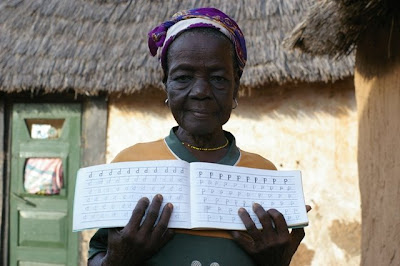

Sanatu, sixty, proves it's never too late to learn.

The NILRIFACU Rice Cooperative

In an effort to learn more about how NILRIFACU’s members see the cooperative, I tried asking Tuferu what he thinks of the group. He said that the cooperative is good because it allows him to purchase seed and fertilizer and coordinate loans with the bank for his entire community. It would be very difficult for farmers to obtain seed and fertilizer individually and banks only give loans to farmer groups. This perception of NILRIFACU is somewhat different than the one I went in with. Because the cooperative has a marketing fund to buy and sell rice, it could in theory be run as a profitable business. As I near the end of my placement, I’m starting to question whether this is really what the executives want to be doing and if it will ever be a viable reality. Regardless, I sense there’s a disconnect between the NGO that established the group and those who are now responsible for running it.


NILRIFACU has a store house in Kukuo where rice is kept from harvest time until when it is sold later in the year.

NERICA Rice and Soil Fertility

Tuferu is a good farmer. In 2003 he was awarded Best Farmer in the District by the Ministry of Food and Agriculture and says he hopes to win it again this year. When officials began the NERICA rice program he was a natural choice to be one of the pioneer farmers.


Tuferu was awarded Best Farmer of the Year in 2003.

I asked Tuferu why he and other farmers in his community grow NERICA rice. From what I gathered, part of the reason stems from the incentives put in place by those promoting the rice including free seed, fertilizer on credit and guaranteed market access. This is somewhat troubling, as these incentive programs are scheduled to end in the next couple years. Tuferu says that while NERICA rice gets lower yields than other rice varieties, he likes that it matures earlier (90 days instead of 120 days) and requires less water. Because NERICA can be harvested a month before other rice varieties, it is less susceptible to late season droughts. He also said that people enjoy the taste of NERICA more than other varieties. I had the opportunity to try some on my last night in the village but despite having eaten more rice this summer than the rest of my life combined, I still hadn’t developed a sophisticated enough pallet to detect the difference.


NERICA rice.

Perhaps the most interesting thing I discovered in Kukuo was the use of compost and animal dung to enhance soil fertility. Each house digs holes about two meters in diameter in which they deposit the leaves and wastes from rice and shea nut processing. The compost is covered with grass and sticks and allowed to incubate for two to four months. They also tie up all the animals during the rainy (and farming) season which has the benefit of keeping the animals from eating the crops, but also allows for the collection of manure. Other communities I’ve observed allow animals to roam free all year round, which not only requires the construction of fences around crops to protect them, but also makes it impossible to collect manure. Farmers in Kukuo transport compost and manure to their fields with bicycles (if they have) or on their heads.


Waste from rice and shea nut processing is deposited in compost holes. The compost is later transported to fields by bicycle or on farmers' heads.


Goats, sheep and cattle are tied up during the farming season allowing for the collection of manure and eliminating the need to construct fences around the crops.

Tuferu’s household used compost and animal dung on their maize. I had a chance to measure and compare the productivity of two maize plots during my stay. Based on my rough measurements and what Tuferu's told me the yields of each have been, the plot on which the compost is applied with less than half the chemical fertilizer yields almost twice as much grain per acre as the plot in which the full recommended quantity of chemical fertilizer is applied.

The results are an approximation at best and there are doubtlessly other factors at play, but I think they indicate an important fact: there are viable alternatives to the use of chemical fertilizers. I asked Tuferu what the greatest obstacles are to increasing the use of compost and manure. He indicated that labour is a major constraint; transporting compost is time consuming. With a 4x4 truck it wouldn’t be so hard he explained, but most farmers cannot afford vehicles. Given the government’s subsidy of chemical fertilizers this year, I’m questioning whether there aren’t other options for boosting agricultural production in the country. Perhaps helping farmers with transport of compost and manure would be more productive? Talking to farmers from other communities, I get the sense that knowledge about composting is lacking as well. Should agricultural extension agents make this a stronger focus?

Final Thoughts

While my stay in Kukuo was extremely educational and I enjoyed aspects of it, it was also very challenging. When I first arrived Tuferu told me that he was “preparing to come to my country”. To put things in perspective, Tuferu doesn’t know where “my country” is, nor does he have the financial means to travel there or the characteristics that would make it possible for him to obtain a visa. When I tried to explain these obstacles, he refuted that he would go to his politicians or an NGO and get them to help him. He explained that he only wants to come for a short time to collect some money and then return.

These types of conversations continued throughout the week and my frustration mounted. One night we almost ended up shouting at each other. Several things bothered me and still bother me. Firstly, he’s under the impression that everyone in the western world is rich. He thinks that if he can only get there, he’ll be able to pick up money off the street and live like a king. He has no idea how hard it is for new immigrants. Coming to Ghana I’ve got a taste of what it’s like to enter a new culture where everything from the food to the toilets is different. If somehow he were to come to Canada he’d likely work at McDonalds, have drunk teenagers yell at him, miss his family and not be able to find TZ anywhere. He’d go from being a knowledgeable and respected member of his community to another struggling immigrant.

So in part I’m frustrated by his stubbornness and what he doesn’t know he doesn’t know. I’m frustrated by how common his attitude is; how so many Ghanaians live for a dream that so few will ever realize, a dream that doesn’t even exist as they imagine it. Not only does it make me sad for them, but it makes me angry because I feel like it removes the incentive and the responsibility people have to improve their own condition. At the same time, Tuferu makes some undeniable points: life in Canada is easier for most people, there are more opportunities. How can I say he shouldn’t dream of having the same things I have? And so I continue to be frustrated by the situation; by the hypocrisy of my own frustration. Maybe it’s not my place to comment. I’ve met numerous Ghanaians who are committed to creating change in their own country and have no desire to leave; perhaps they’re the ones who have to do the real convincing.

Frustrations aside, there’s nothing quite like lying under the stars on a warm African night listening to Dagbani music crackle through the radio. I asked Fatowu what he believed the stars were. He said only god knows, but that each person has a star and that when they die their star is gone as well. There’s something comforting in that; that you can look up and see the whole world in the sky. It wasn’t an easy week, but it was one that I’ll remember for a long time - especially when I look up at the stars.


It was a memorable week.

Saturday, July 12, 2008

Ben's Bus

“I forgot to tell you the name,” he says to me, “it’s going to be called Time.” In a country where punctuality is rare and most forms of transportation simply leave when they’re full, Ben has a vision for something different. Time is the name of his bus and it does just that; leave on time.

I first met Ben when he wandered into my office on business for the local government where he works as a development planner. Ben landed his job by starting as a volunteer completing the year of National Service all post secondary graduates in Ghana are required to undergo. When the former planner left for another job, Ben’s motivation and willingness to work hard made him a clear choice to fill the position.


Ben dreams of starting his own bus company called Time.

Since our first meeting Ben and I have got together several times, mostly to talk about his dream: Time. To start, Time is a single coach style bus that holds roughly fifty people. It makes a single one-way trip between the Ghanaian cities of Tamale and Wa (a distance of about 200 km) each day. “There are always people lined up to go,” he tells me, “it’ll be easy to fill the bus.” Currently the route is served by government buses, but service is often limited and passengers can only speculate on when the bus will depart and arrive.


Government transit (and most transit for that matter) is often erratic and unreliable.

The cost of the bus Ben wants to buy is about 40,000 Canadian dollars. Based on what existing travelers pay, he expects to be able to charge seven dollars for a one-way trip. Even after paying for fuel, maintenance and the driver’s salary, Ben estimates he would be able to recover the initial capital cost within a year.

So what’s stopping him? “Banks in Ghana won’t even consider start up businesses,” he explains, “if I could get the [startup] money I would start the business tomorrow.” Ben, like the vast majority of Ghanaians, has no way of obtaining credit. Although his business requires a relatively large capital input, even the country’s smaller scale would-be-entrepreneurs are handicapped because they cannot obtain loans. Those who can obtain loans frequently pay annual interest rates of twenty-five percent or more.

Although the government and NGOs provide a limited number of agricultural loans to organized farmer groups, I’ve met countless farmers who explained that they did not use chemical fertilizers on their crops because they could not afford the initial cost. Although they knew they would be able to recover the investment at harvest time, the farmers had no way of obtaining the initial capital. Similarly, the women’s rice processing group that I work with would be able to produce high quality rice and sell it at more than double the price they currently receive if only they could afford the right equipment. It’s a story that gets repeated over and over again.

I asked Ben why he wants to start his business. He admits it partially has to do with his own financial security, but explained that it’s about more than just money. “My business will create employment,” he tells me. “I’m going to be helping to employ drivers, ticket sellers, mechanics and accountants.” Perhaps even more importantly, he’s going to be providing a much needed service: reliable transportation. This service has spin off benefits for the rest of the economy. Instead of waiting around for a bus that might never show, people will have extra time to devote to work. At the same time, others will find it easier to do business in Wa knowing that they will be able to obtain timely transportation to and from Tamale (a major business centre).

Before coming to Ghana, the idea of starting or investing in a business had never crossed my mind. Business, I thought, was for those who only care about making money. But more and more I’m realizing how much business is linked to development. For now, aid is still critical. It provides the engine for much of the country’s social development, including health and education. But business means employment and government tax revenue, both of which are essential if Ghana ever hopes to escape it’s reliance on foreign aid (and all that it entails).

My perception of how Canadians can help the developing world has shifted. Giving money to reputable NGOs and lobbying the Canadian government to end unfair agricultural subsidies and trade barriers is important, but I think doing business in Ghana is equally as important. Those of a more philanthropic inclination can lend their money to micro-enterprise projects through Kiva.org or other organizations, which is a positive start as the growth of small business is most likely to benefit the poor. At the same time, I think there are opportunities for real profit as well. Many are quick to point fingers at those who make money in the developing world, but making money almost always means employing people and to me that's positive. Everyone is familiar with stories of one multinational corporation or another committing unspeakable acts in the developing world, but I think these are the exceptions, not the rules. The Integrated Tamale Fruit Company is an excellent example of how business can mean both profit and development.

The developed world is full of accessible capital, the developing world is full of opportunities and ambitious entrepreneurs like Ben; somehow we need to bridge the gap.

Friday, July 11, 2008

How to Grow Rice

1. Obtain some rice seed. Rice seed is rice that hasn't had the husk removed. To a farmer this may seem like an obvious fact, but it wasn't to me so I thought I'd mention it here.

2. Plow your field. Enlisting the services of a tractor will cost about 25 Canadian dollars per acre, while a bull ox is slightly less.

3. Use sticks and rope to delineate rows about 15cm apart.


4. Take a larger stick and 'dibble' by making small holes at 15cm intervals. Although you have the option of 'broadcasting' your seed by throwing it and using a tractor to mix it into the soil, this approach is less effective. Seeds are not always covered uniformly, are more susceptible to attack by birds. Dibbling and planting in rows also allows for more efficient use of chemical fertilizer as it can be placed in holes directly adjacent to the rice, ensuring maximum absorption.


5. Place roughly 5 grains of rice in each hole. This is a good time to enlist the assistance of some extra labour.


6. Cover the holes by stomping on them with your feet. It helps to have a good large group of people.


7. Planting is complete. Take a rest before returning to the village.


8. After 2 or 3 weeks, apply two bags of NPK (Nitrogen, Phosphorous, Potassium) 15-15-15 fertilizer by dibbling holes next to the rice stocks. One bag of Sulphate of Ammonia fertilizer should be applied as a top dressing (broadcast) after about a month.


9. Watch your rice grow!

Wednesday, July 2, 2008

My Compound

Oops, I almost forgot to post this.

I thought it might be interesting for people to see what my compound in Tolon looks like. Graphics courtesy of Rick Kim.


My compound in Tolon. Click to enlarge.

Thursday, June 26, 2008

Tolon, Revisited

As I near the middle of my placement and have surpassed my sixth week in Tolon, I feel like the town deserves another visit.

Life here is good. My health was somewhat sub-optimal earlier in my placement, but I’ve been feeling surprisingly healthy for the last week or two. Last night I finished an entire bowl of rice, a feat I had accomplished only once previously. I also consumed a smaller bowl of rice in the morning, four bags of groundnuts (peanuts), five bananas, half a mini-loaf of bread and what was probably too much choco delight (made-in-Ghana chocolate spread). The ten kilometer bike ride helped.

I’m still eating a lot of rice and maize, but they’re starting to grow on me. My favourite local food is probably waakey (“wa-chay”), which is made from rice and beans. Adisa (my host mother) sells waakey to school children every morning and I almost always go and buy it from her.


I eat waakey (rice and beans) every morning. The noodles are a bit of an extra touch.

Teazed (maize flower) is typically what we eat for dinner, although the type of soup varies. Almost all feature peppers and dehydrated fish, but my favourite is okra mostly because it includes the ever elusive green vegetables. Dinner can also take the form of rice balls (basically teazed but with giant balls of rice instead of maize) or jollof rice, which is rice cooked in a pepper sauce. The other night we had jollof watchay, which was a spectacular surprise.


Teazed is made from maize flower. The type of soup can vary; some have a tomato base while others are made from groundnuts.

On the weekends I tend to succumb to my love of eggs and fry up four or five for lunch. The concept of fried eggs isn’t foreign in Tolon, but from what I’ve seen it’s only the men who really eat them and don’t seem to do so often.


Frying eggs on a charcoal cook stove.

A couple weeks ago Tolon had a surprise visit from the American military. Naturally I was a little surprised to find marines parked outside the front of our compound, so I decided (along with half of Tolon) to go and investigate. The Americans went to greet the town elders (the chief was in Accra) and most people followed to watch. Unfortunately spectation isn’t really an option for a tall white man in Tolon and I ended up sitting in the front with all the soldiers as they talked with the elders and explained their mission. At first I thought they were part of the training operation the Americans are doing in Ghana, but they said they were actually veterinarians doing a routine service operation. Apparently they fly all over the world and go around de-worming goats and cows. They also have a human health unit. I’m still a little skeptical that their presence doesn’t have anything to do with the training operation, but they did go around treating animals the following day. I also can’t imagine how flying American military vets to various regions of the world is a cost effective development strategy. Perhaps it has less to do with poverty reduction and more to do with improving the global image of American forces abroad.


American forces outside my home in Tolon.

As there aren’t always American soldiers in town, I have to find other ways to occupy my time. Since on of my goals of being in Ghana is to learn as much about Ghanaian life as possible, I devised a list of things I want to do before I leave. When I have some extra time I browse the list and pick an adventure to tackle. One Sunday I decided I was going to go pray at the nearby mosque.


The nearby mosque. One of five or six in Tolon.

Muslims (at least the ones in Tolon) pray five times a day. The first prayer is at 5:30am, then again at 1pm, 3pm, 6:30pm and 7:10pm. Each time one of the old men will go inside the mosque about fifteen minutes beforehand and start broadcasting his prayers through the megaphone on the roof of the mosque. While some volunteers have expressed irritation at waking up to this, I don’t mind it so much. Participating in the morning prayer was actually my favourite; the air was still and the sun had not yet risen. The actions of bowing on the knees and chanting give it an almost meditative feel. I also learned how to do abolishment, which involves using water to wash the hands, head and feet before entering the mosque.

I was a little concerned about my presence being disrespectful, but my friend Mohammed reassured me that it was okay for me to participate. After the first prayer was over the old men smiled at me and were eager to shake my hand, making me feel welcome. It wasn’t until the evening that I realized people had assumed I was planning to come every day to pray. Even now people will still jokingly ask me to come to pray with them. In retrospect I probably should have been a lot clearer on my intentions. I’m not entirely sure if I’ve offended anyone and don’t know if I would go back and do it again, but I’m still very grateful for the experience. I would probably never have even seen the inside of the mosque otherwise.

Life with my family has also evolved. Ayisha and I will joke around a lot and I feel like a strong friendship is developing. Sometimes she’ll help and/or laugh at me wash clothes, other times I’ll help her read or carry water. Mostly I think she finds me amusing and I enjoy the way her face lights up when she first sees me. Sala, who is called Ma Sala or “Mother Sala” because there are too many Salas, is as happy as ever. It’s pretty hard not to find her chubby waddling little walk cute. Sometimes I try to get her to talk to me by asking her simple questions in Dagbani like “where are you going?”, “what are you doing?” or “where are you eating?”, but she usually only talks to her direct family. Baba doesn’t speak much English, but I’ve noticed our relationship change. We still don’t have a lot of interaction, but he’s started to find me less intimidating and more amusing. He and some of the other children have started calling me “Brother Sam” which I think is a further indication that they consider me more approachable. My host mother, Adisa, loves to talk loudly in a big stern voice, but is really quite loving and often jokes around with her children. When I walk through town people usually greet me in my Dagbani name, “Wumpini” and ask how I am or where I’m going. In many ways I feel like the town mascot. People find me amusing, but I also feel like there’s a growing level of respect. I feel welcome.


Ayisha, 13 years old.


Ma Sala ("Mother Sala"), 3 years old.


Baba, 9 years old.

In coming to Ghana, one of my greatest fears was that I wouldn’t be able to connect with people. I’ve always been a bit of an introvert and had seen this as a weakness in terms of integrating into a new culture and building relationships. My experience has been quite the opposite. Whatever insecurities I have about my placement from a work point of view, I feel good about the successes I’ve had at making friends and becoming a part of life in Tolon. Last night Adisa told Ayisha to ask me how long it’s been since I came to Tolon and how long I’m going to stay. When I told them two more months they were a little bit upset. They asked who will make them laugh in the evenings once I’ve gone. Before I leave, they said, I have to be sure I take a picture with them and Baba and Ma Sala and get it printed.

I was telling Sarah about this experience and she asked me what I think I’ve done to be so successful at building these relationships. Honestly, I think a lot of it is just having the good fortune of finding an awesome family in an awesome town. When I came to Tolon I had hoped to get to know people, make a few friends and be able to say I didn't screw it up too badly. I never expected to have people miss me; I never expected to leave feeling loved.


Playing owaray (African stones game).


Ayisha (front, in black) and some of the other kids who live near my home.

Wednesday, June 25, 2008

Time

I remember Sarah Lewis (a returned long term volunteer with EWB) once said that the biggest difference between her first four months in Ghana and her first year was that she learned who her real friends were. I wouldn’t say I’ve had exactly the same experience during my first six weeks here, but I am beginning to appreciate how understanding grows and changes with time. Looking back at my previous perceptions of life in Ghana, I find them riddled with flaws and misconceptions. I’ve also come to recognize that I felt this same way after two weeks and will almost certainly feel the same way after three and a half months.

In a way it’s a bit like calculus. If we let variable U represent understanding and variable t represent time spent in Ghana and consider that understanding is a function of time we obtain:


If we then realize that the more time someone spends in Ghana the closer they come to obtaining perfect understanding, but also that it is never possible to actually achieve perfect understanding, we obtain the function:


In short, I’m starting to realize how very very important it is to spend time. I suppose this idea applies to any field, but I think it’s particularly relevant to international development. Of course there’s never enough time and there’s always an opportunity cost to spending more time. Individuals and organizations hoping to create positive change have to find a balance; what portion of their limited resources do they spend trying to understand their intended beneficiaries and what portion do they spend trying to help them. Anthropologists obviously focus on trying to understand and occupy one end of the extreme, whereas the well intentioned eighth grader organizing a Christmas cheer box full of toothbrushes, plastic dolls and crayons occupies the other end of the extreme. I don’t think either approach is particularly ideal, but feel that generally there isn’t enough emphasis on spending time to understand.

So what’s the right amount of time? I’ve been grappling with this question ever since arriving. On the one hand I want to know that what I’m doing is actually going to have a positive influence on the poor in Ghana, but at the same time recognize that this concern can be paralyzing. While I don’t want to leave having spent all my time working on a project that isn’t addressing the real causes of poverty, I also don’t want to leave having spent all my time questioning and not doing. Eric Dudley in The Critical Villager says something along the lines of “you have to dream for success while looking back and being critical”. For me the toughest part is truly believing in that success and not getting hung up on the obstacles. Of the many lessons I take away from Ghana, I think one of the greatest will be that of accepting imperfection and learning to embrace small achievements.